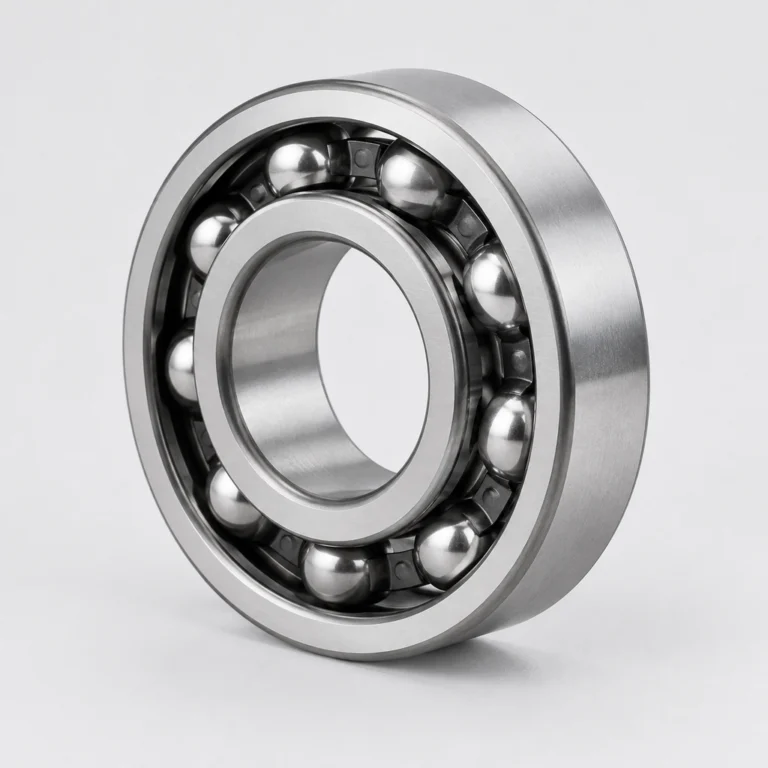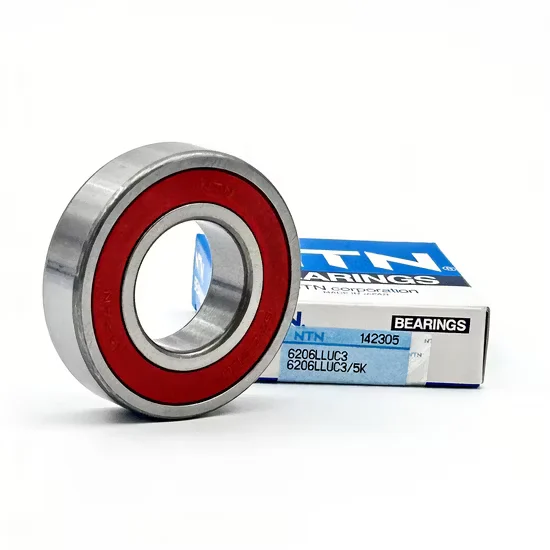
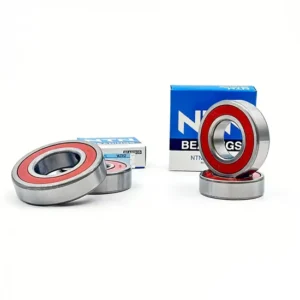
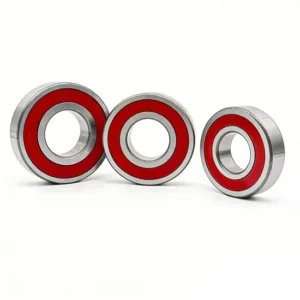
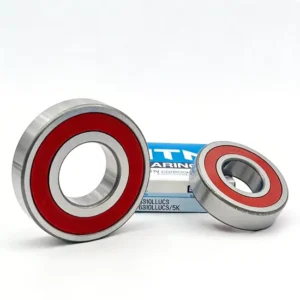
Multi-Brand Sourcing Unified — Consolidate your NTN 6206 deep groove ball bearing orders alongside other premium makes in a single shipment, eliminating the friction of coordinating multiple suppliers and reducing overall logistical overhead for your maintenance department.
Technical Specifications
| Parameter | Value |
|---|---|
| Designation | NTN 6206 |
| Bearing Type | Deep Groove Ball Bearing |
| Bore Diameter (d) | 30 mm |
| Outside Diameter (D) | 62 mm |
| Width (B) | 16 mm |
| Material | Bearing Steel |
| Lubrication | Grease or Oil |
| Origin | Japan |
Application Suitability
| Industry | Typical Applications |
|---|---|
| CNC Machining | Spindle support and precision feed drive mechanisms |
| Industrial Gearboxes | High-speed reduction shaft supports and torque transmission |
| Electric Motors | Rotor shaft alignment requiring low-noise operation |
| Fluid Pumps | Impeller shaft stabilization under continuous radial loads |
Why Spindle Vibration Ruins Tolerances Before the NTN 6206 deep groove ball bearing Fails
Micro-vibrations from mismatched internal clearances destroy surface finishes long before catastrophic bearing seizure occurs.
Early in my career analyzing machinery failures, I dismantled a CNC spindle where an incorrectly specified deep groove ball bearing caused severe cage wear. The resulting high-frequency noise and vibration scrapped countless precision workpieces, costing the facility significant rework time and damaging the machine’s reputation for precision. Sourcing genuine components with exact tolerance matching prevents these silent tolerance killers. When procurement teams prioritize lowest cost over precision verification, the hidden expense of scrapped parts quickly eclipses any initial savings [NEED_CITE: rolling bearing failure mode classification per ISO 15243].
Matching Precision Requirements for Machine Tool Spindles
When integrating a NTN 6206 deep groove ball bearing into high-speed machinery, the primary focus must be on rotational accuracy and thermal stability. Our engineering team cross-references your specific spindle load profiles to ensure the selected component maintains geometric stability under dynamic cutting forces. This proactive matching eliminates the guesswork often encountered when replacing critical rotating elements. By analyzing the exact fit tolerances of your shaft and housing, we prevent the micro-movements that lead to fretting corrosion and premature degradation.
Managing Thermal and Lubrication Challenges
High-speed spindle operations generate significant frictional heat, directly impacting internal clearance and lubricant viscosity. Selecting between grease or oil lubrication depends entirely on the cooling mechanism and rotational velocity of the host equipment. Inadequate thermal dissipation leads to lubricant degradation, accelerating surface fatigue and compromising the raceway integrity [NEED_CITE: thermal effects on bearing fatigue life per ISO 281]. Proper sealing selection is equally critical to prevent coolant contamination without introducing excessive frictional drag. Maintenance teams must also establish strict relubrication intervals based on the specific thermal load to maintain optimal film thickness.
Decoding the Core Dimensional and Material Profile
The 30 mm bore, 62 mm outside diameter, and 16 mm width define a compact footprint ideal for space-constrained motor and gearbox housings. While standard configurations utilize high-carbon bearing steel for optimal hardness and load capacity, specialized material variants are available upon request for corrosive environments. The flexibility to specify either grease or oil lubrication allows maintenance teams to align the component with existing centralized lubrication systems. This dimensional standard ensures direct drop-in replacement for legacy equipment without requiring shaft or housing modifications. Furthermore, the precision grinding of the raceways ensures smooth operation, minimizing the acoustic signature in noise-sensitive applications like medical equipment or precision testing rigs.
The Hidden Toll of Incorrect Clearance Selection
Specifying the wrong internal clearance class inevitably leads to unplanned downtime and premature failure. When thermal expansion exceeds the designed clearance limits, the rolling elements experience excessive preload, generating destructive heat. This cascading effect often results in catastrophic damage to the surrounding shaft and housing, voiding equipment warranties and requiring extensive mechanical repairs. Adhering to standardized failure analysis frameworks helps identify these root causes before they escalate into complete system breakdowns [NEED_CITE: bearing damage classification per ISO 15243]. Procurement engineers must evaluate the entire thermal system rather than just the ambient temperature.
Securing Authentic Components for Critical Rotating Assets
Sourcing genuine parts requires more than just matching a part number; it demands rigorous verification of the manufacturing origin. We provide complete batch traceability for every unit, ensuring the Japanese origin is fully documented and verifiable. Our flexible minimum order quantities allow you to order a single emergency replacement or consolidate a full container of mixed sizes for planned overhauls. Furthermore, our technical team provides cross-brand equivalent model consultation if legacy cross-references are obsolete or discontinued. This comprehensive support guarantees that your maintenance schedules remain uninterrupted while strictly adhering to original equipment specifications.
Documentation & Authenticity
- Certificate of Conformity confirming Japanese manufacturing origin for each batch.
- Original factory batch traceability documentation linking the unit to its production run.
- Dimensional inspection reports verifying the 30x62x16 mm tolerances before dispatch.
- Official manufacturer QR codes for immediate digital authenticity verification.
Storage, Handling & Mounting
- Retain original factory packaging to protect the bearing steel surfaces from ambient humidity.
- Use induction heating for the 30 mm bore to avoid mechanical stress during shaft mounting.
- Apply clean lint-free gloves to prevent skin acids from corroding the unlubricated raceways.
- Verify grease or oil compatibility before introducing external lubricants to the open variant.
Engineering Review and Selection Guidance
To ensure optimal performance, please provide your specific radial and axial load profiles, operating speeds, and thermal conditions. Supplying the original equipment manufacturer part numbers allows our team to perform precise cross-reference verification and identify any superseded design iterations. This technical review guarantees the selected component aligns perfectly with your machinery’s operational demands. Additionally, sharing details about the housing fit and shaft tolerances enables us to calculate the final installed clearance, preventing costly installation errors. Our engineers will then generate a comprehensive L10 life calculation to validate the selection.
Frequently Asked Questions
Q: How can I verify the authenticity of this specific model using official tools?
A: You can verify the authenticity by scanning the official manufacturer QR code printed on the packaging using their dedicated mobile application. This digital check confirms the production batch, Japanese origin, and ensures the unit is not a counterfeit. We also supply original factory traceability documents with every shipment for additional procurement compliance.
Q: What factors dictate the choice between grease and oil lubrication for this application?
A: The choice depends primarily on the operating speed and the host equipment’s cooling capabilities. Oil lubrication is typically preferred for high-speed spindle applications requiring superior heat dissipation, while grease is ideal for sealed, maintenance-free electric motor setups. Our technical team can evaluate your specific thermal conditions to recommend the optimal lubrication strategy.
Q: How do I determine the correct internal clearance class for my operating temperature?
A: Internal clearance must account for the thermal expansion of the shaft and housing during operation. Standard clearance suits general industrial applications, but high-speed or high-temperature environments often require larger clearance classes to prevent excessive internal preload. Sharing your exact operating temperature range and fit tolerances allows us to calculate the precise clearance requirement.
Q: Can this model be cross-referenced to other international brands if stock is limited?
A: Yes, this standard dimension profile can be cross-referenced to equivalent models from other premium global manufacturers. Our engineering team maintains comprehensive cross-reference databases to identify exact dimensional and performance matches. Providing your original equipment specifications ensures the alternative brand meets the exact load and speed requirements of your application.