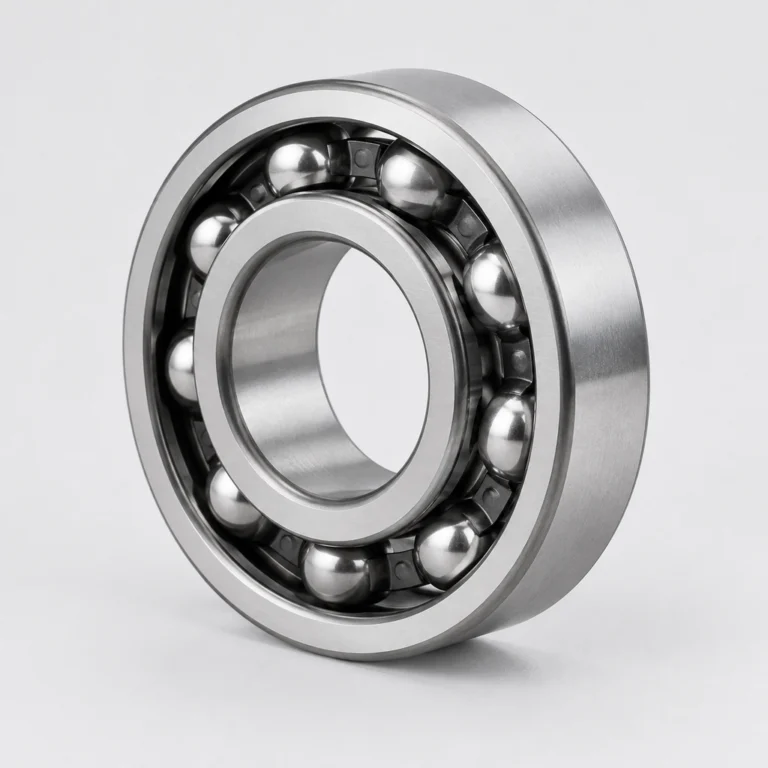
Traceable Japanese Origin — Every NTN 33214 shipment includes verifiable mill batch records linking directly to the manufacturing facility in Japan.
Technical Specifications
| Parameter | Value |
|---|---|
| Designation | NTN 33214 |
| Bearing Type | Tapered Roller Bearing |
| Bore Diameter (d) | 70 mm |
| Outside Diameter (D) | 125 mm |
| Width (T) | 41 mm |
| Lubrication | Grease or Oil |
| Origin | Japan |
Application Suitability
| Industry | Typical Applications |
|---|---|
| Automotive | Wheel hub assemblies and differential carriers |
| Heavy Trucks | Drive axles and final reduction gearsets |
| Industrial Machinery | Heavy-duty gearbox shafts and reducer drives |
Thermal Shock Risks in NTN 33214 Tapered Roller Bearing Assembly
Flame heating destroys the metallurgical structure and guarantees premature spalling.
I witnessed this firsthand in Indonesian mining operations when maintenance crews used open torches to force-fit a 33214 unit, instantly ruining the heat treatment and causing early spalling. Such thermal abuse leads to catastrophic raceway failure long before the calculated L10 life is reached [NEED_CITE: rolling bearing failure mode classification per ISO 15243]. Proper induction heating and strict temperature limits are non-negotiable for preserving the internal geometry of this NTN 33214 tapered roller bearing. Ignoring these protocols results in severe financial losses and compromised equipment reliability across the entire fleet.
Matching the 70x125x41 mm Profile to Drivetrain Loads
The specific 70 mm bore and 125 mm outside diameter make this component ideal for compact yet heavily loaded shaft configurations. In industrial gearboxes and truck axles, the 41 mm width provides the necessary contact area to resolve combined radial and axial forces effectively. Sourcing an authentic NTN 33214 tapered roller bearing ensures the exact dimensional tolerances required to maintain optimal load distribution across the roller paths without edge stressing. This precise geometry prevents localized fatigue and extends the operational lifespan of the entire drivetrain assembly under continuous heavy-duty cycling.
Navigating Lubrication and Contamination in Heavy Gearboxes
Gearbox environments subject these components to intense churning, elevated operating temperatures, and fine metallic particulates. Choosing between grease and oil lubrication depends entirely on the housing design and cooling capacity of the specific reducer. Oil splash systems effectively carry away heat but demand rigorous filtration to prevent abrasive wear, while grease setups require precise relubrication intervals to avoid churning losses [NEED_CITE: lubrication degradation mechanisms in enclosed gear drives]. Effective sealing at the housing level is critical to keep contaminants out of the rolling elements and maintain the integrity of the lubricant film.
Decoding the Baseline Geometry and Lubrication Flexibility
Without any modifying suffixes, this baseline configuration relies on standard internal geometry optimized for general industrial and automotive drivetrain use. The 70x125x41 mm dimensions dictate the fundamental load-carrying capacity and shaft sizing constraints. Its compatibility with both grease and oil allows maintenance teams to adapt the lubrication strategy based on the specific gearbox or axle housing design. The absence of specialized cage or clearance suffixes indicates a standard pressed steel cage and normal internal clearance, which suits the majority of moderate-speed, heavy-load applications where thermal expansion is managed by the housing. This straightforward design simplifies inventory management for global MRO operations.
The Financial Impact of Improper Mounting Practices
Forcing a bearing onto a shaft or applying uncontrolled heat results in micro-cracking and immediate dimensional distortion. These installation errors void manufacturer warranties and trigger unplanned downtime that heavily outweighs the initial component cost. According to ISO 281 standards, actual service life drops drastically when mounting practices compromise the raceway surface integrity [NEED_CITE: life modification factors for mounting and operational conditions per ISO 281]. Investing in proper hydraulic nuts and calibrated induction heaters protects the asset and ensures predictable maintenance scheduling. Neglecting proper tooling inevitably leads to secondary damage on adjacent shafts and housings.
Securing Authentic Supply Chain Integrity
Counterfeit tapered roller bearings frequently fail under the combined loads of truck axles due to substandard steel purity. We eliminate this risk by providing complete traceability documentation for every NTN 33214 tapered roller bearing we dispatch. Our flexible consolidation shipping allows you to mix this exact 70 mm bore unit with other critical MRO spares in a single container. Furthermore, our technical team reviews your application parameters to confirm that the standard internal clearance and baseline geometry perfectly match your specific gearbox operating temperatures. This comprehensive approach guarantees that your procurement strategy aligns with long-term reliability goals.
Documentation & Authenticity
- Certificate of Conformity verifying Japanese manufacturing origin for this specific batch.
- Mill test reports confirming the metallurgical grade of the bearing rings and rollers.
- Dimensional inspection records validating the 70x125x41 mm tolerances prior to dispatch.
- Anti-counterfeit packaging seals intact on the original carton for field verification.
Storage, Handling & Mounting
- Store the original carton in a climate-controlled area to prevent condensation inside the 70 mm bore.
- Use calibrated induction heaters limited to 110°C to expand the inner ring without altering the heat treatment.
- Never use open flames or torches, as thermal shock destroys the raceway hardness and causes early spalling.
- Apply a thin layer of compatible oil to the 125 mm outer ring before pressing into the housing bore.
- Verify the shaft shoulder fillet radius to ensure the 41 mm wide inner ring seats squarely without interference.
Preparing Your Technical Inquiry
To ensure this baseline configuration meets your exact operational demands, please share the specific radial and axial load profiles along with the operating temperature range. Providing the OEM equipment model number allows our engineering team to cross-reference the housing design and confirm the suitability of standard internal clearances. If your gearbox operates under extreme thermal gradients, we can evaluate whether a modified clearance class is necessary for your specific application.
Frequently Asked Questions
Q: How can we verify the authenticity of the NTN 33214 bearings upon delivery?
A: Authenticity is confirmed through verifiable batch traceability documents linking the physical carton to the Japanese manufacturing facility. Inspect the original packaging for intact anti-counterfeit seals and laser-etched markings on the bearing rings. We provide complete supply chain documentation to eliminate the risk of counterfeit parts entering your critical drivetrain and heavy-equipment maintenance inventory.
Q: What are the practical differences in application between standard and higher precision classes?
A: Standard precision is entirely sufficient for heavy-duty truck axles and general industrial gearboxes where load capacity matters more than ultra-high rotational accuracy. Higher precision classes are typically reserved for machine tool spindles or specialized automotive hubs requiring minimal runout. Selecting an unnecessarily high precision grade increases procurement costs without delivering measurable performance benefits in standard power transmission applications.
Q: How do we select the appropriate lubrication for this bearing in industrial gearboxes?
A: The choice between grease and oil depends on the gearbox housing design, cooling capacity, and operational speed. Oil splash systems are preferred for high-speed or high-temperature reducers to efficiently dissipate heat, while grease is suitable for sealed or slower-turning assemblies. Always ensure the chosen lubricant is compatible with the gearbox seals to prevent chemical degradation and subsequent contamination ingress.
Q: What installation procedures prevent the early spalling seen in mining equipment?
A: Never use open flames or uncontrolled torches to heat the inner ring, as this destroys the metallurgical structure and causes premature raceway failure. Always use calibrated induction heaters with strict temperature limits to expand the 70 mm bore safely. Ensure the shaft is clean, and apply controlled axial force only against the inner ring during press-fitting to avoid damaging the rolling elements.